
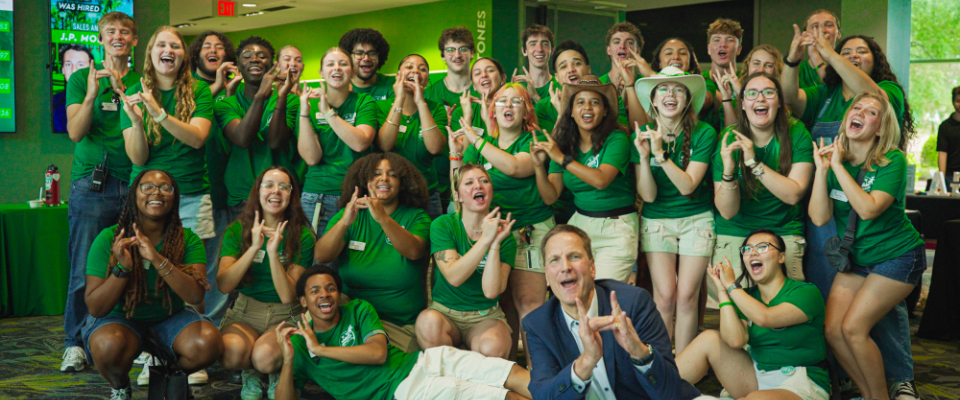
New Counselor Education Cohort Model
NOW ACCEPTING APPLICATIONS FOR FALL 2027
Two clear paths to a counseling career. Finish in two years or three, with one admission cycle each fall.
Request Information Compare the Pathways
Learn together. Graduate on schedule.
Beginning in Fall 2027, our MS programs in Clinical Mental Health Counseling and Marriage, Couple and Family Counseling will admit students as cohorts. Each entering class moves through a set course sequence together, from first class to graduation.
A built-in professional community
Move through the program with the same classmates and build a network you will lean on long after graduation.
Your schedule, set from day one
A planned course sequence means you know exactly what you're taking each term and when you'll finish.
CACREP-accredited programs
Both programs are accredited by the Council for Accreditation of Counseling and Related Educational Programs.
Same degree. Two timelines.
CHOOSE YOUR PATHWAY
Two-year pathway
Designed for students who can make graduate school their primary focus and want to enter the field sooner.
| Length | 2 years |
| Starts | Fall |
| Credits per term | 12 |
| Practicum begins | Summer, Year 1 |
Three-year pathway
A lighter course load each term, built for students balancing work, family, or other commitments.
| Length | 3 years |
| Starts | Fall |
| Credits per term | 6-9 |
| Practicum begins | Summer, Year 2 |
Both pathways are offered for the MS in Clinical Mental Health Counseling and the MS in Marriage, Couple and Family Counseling.

Important Dates
- Applications open: Sept. 2026
- Information sessions (noon EST): Oct. 20, Nov. 17, Dec. 8, Jan. 12, and Jan. 26
- Application deadline: Feb. 1, 2027
- Cohort begins: Aug. 2027
How the Cohort Model Works
In a cohort model, you start the program with a group of classmates and take a planned sequence of courses with them, from your first semester, through practicum and internship, to graduation. You will know from the start which courses you will take each term and when you will graduate.
A cohort gives students a clear, predictable path to graduation and a built-in professional community. Data suggests that students in graduate counseling programs value a structured plan and close connections with peers.
Both pathways cover the same courses and lead to the same 60-credit degree. The only difference is pacing:
- Two-year pathway: 12 credits per term in Fall, Spring, and Summer of year 1, as well as Fall and Spring of year 2. Practicum is in the first summer and internship in the second year.
- Three-year pathway: 6 to 9 credits per term. Practicum is in the second summer and internship in the third year.
Choose the pace that works for you. The two-year pathway is the fastest route into the field. The three-year pathway gives you more time to absorb what you are learning, more coursework before you begin practicum, and tuition spread across more terms. Neither pathway is the “standard” one; both lead to the same degree and the same preparation for licensure.
Yes. Both degrees share the same core courses, plus two specialization courses in your major.
No. Beginning with the Fall 2027 cohort, students choose one major: Clinical Mental Health Counseling or Marriage, Couple, and Family Counseling. Each pathway is built around a set sequence of courses and clinical placements, and completing both majors would add extra internship semesters and time to your degree.
Both majors share most of their core courses, including family systems and psychopathology across individuals, couples, and families, so you will build a foundation in both individual and relational work whichever major you choose. Not sure which fits you best? We can help! Please reach out to us.
Yes. Both pathways lead to the same degree, and our Clinical Mental Health Counseling and Marriage, Couple, and Family Counseling programs are accredited by the Council for Accreditation of Counseling and Related Educational Programs (CACREP).
Yes. The degree includes two elective courses (6 credits), offered in the summer. Current options include:
- Understanding Religious and Spiritual Themes in Counseling
- Spirituality in Counseling Practice
- Play Therapy Theories and Practices
- Play Therapy and Creativity with Families and Special Populations
- Utilizing Expressive Arts in Counseling
- Counseling Children and Adolescents
- Individual, Couple, and Family Advanced Techniques and Treatment Planning
Cohort sizes may vary with each admitted class, but our programs are small by design, so you will know your classmates and your professors, courses are discussion-based and experiential, and practicum and internship are taught in supervision groups that follow accreditation standards, meaning you get individual attention throughout your clinical training.
What to Know Before You Apply
Yes. Your application will ask which pathway you prefer. If you are admitted, you will confirm your final choice before your first semester begins.
No. Beginning with Fall 2027, the department admits one cohort a year, for Fall entry only. The application deadline for Fall 2027 is Feb. 1, 2027.
Yes. You may by able to transfer up to 6 graduate credits from a comparable counselor education program at a regionally and CACREP-accredited institution. Transferred courses must be similar in content and rigor to Stetson’s courses, must have been completed with a grade of B or higher, and cannot include practicum or internship. Requests are reviewed by the department chair. See the Counselor Education Student Handbook for more information.
Approved transfer credits would not shorten your program. You would stay with your cohort and skip the transferred course, which would give you a lighter load that term. Because skipping a transferred course could bring some terms below 6 credits of enrollment at Stetson, which would affect full-time status and financial aid, check with the Office of Graduate Studies and the Office of Student Financial Aid before transferring credits in.
Each pathway is built around a set sequence that you complete with the same group of classmates. That is what keeps your path to graduation predictable, so switching pathways is not an option once you begin. If something unexpected happens, such as a health or family situation that requires time away, you will have an adviser to speak with about your options.
Many students work during the program, and the three-year pathway’s lighter course load makes that easier to manage. On either pathway, practicum and internship add 800 hours at a clinical site, and sites often need you available during business hours, so many students adjust their work commitments during those semesters.
Courses for both pathways are currently offered in the afternoon and evening. Keep in mind that practicum and internship sites often require some availability during business hours.
Both pathways include the same 60 credits, so tuition for the full degree is the same. What differs is how that cost is spread out. The two-year pathway concentrates tuition into fewer, fuller terms. The three-year pathway spreads it across more terms, which lowers your cost each year. Because federal student loans have annual borrowing limits, cost per year can be an important part of choosing a pathway. We encourage you to meet with the Office of Student Financial Aid early to plan for the pathway that works for you.
Current Students: What This Means for You
Enrolled before Fall 2027? Here’s how the transition affects you.
No. If you enrolled before Fall 2027, you will finish your degree under your current plan of study. You will earn the same M.S. degree, with the same accreditation and the same preparation for licensure, as students in the new cohorts.
Yes. The department will keep offering the courses current students need to graduate. Some courses may move to a different semester than they are offered in now, but, your advisor will work with you to update your plan of study and keep you on track to graduate as planned.
No. Students enrolled before Fall 2027 will finish under their current plan of study, and you will continue taking classes alongside your current classmates. During the transition, some courses may also include students from the new cohorts.
Possibly. We are developing a bridge option that would let Spring 2027 students align their coursework with the first cohort beginning in Fall 2027. Details are still being finalized, and we will share them with Spring 2027 students directly. In the meantime, please talk with your advisor about your plan of study.
COUN 521 and 525 remain required under your current plan of study and will continue to be offered. They become electives only for students who start in a cohort beginning Fall 2027. The elective courses are ones the department already offers, so you can take them as your plan of study allows.
No. The Advanced Studies curricular options, including the dual major, will no longer be offered starting in Fall 2027, but if you are currently enrolled in either, you can complete your program under your current plan of study. Talk with your advisor if you have questions.
No. The department coordinates clinical placements for all students, and the move to cohorts will not create competition for practicum or internship sites. Your advisor and our department's clinical coordinator will continue to support you through the placement process just as they do now.
Your faculty advisor is your best first contact and will continue to support you on your current plan of study.
Start with the Fall 2027 cohort
Questions about the cohort pathways?
Email the Department of Counselor Education at [email protected].
Questions about applying?
Email Graduate Admissions at [email protected] or call 386-822-7100.
Request Information