The Lake Beresford Historic Mural
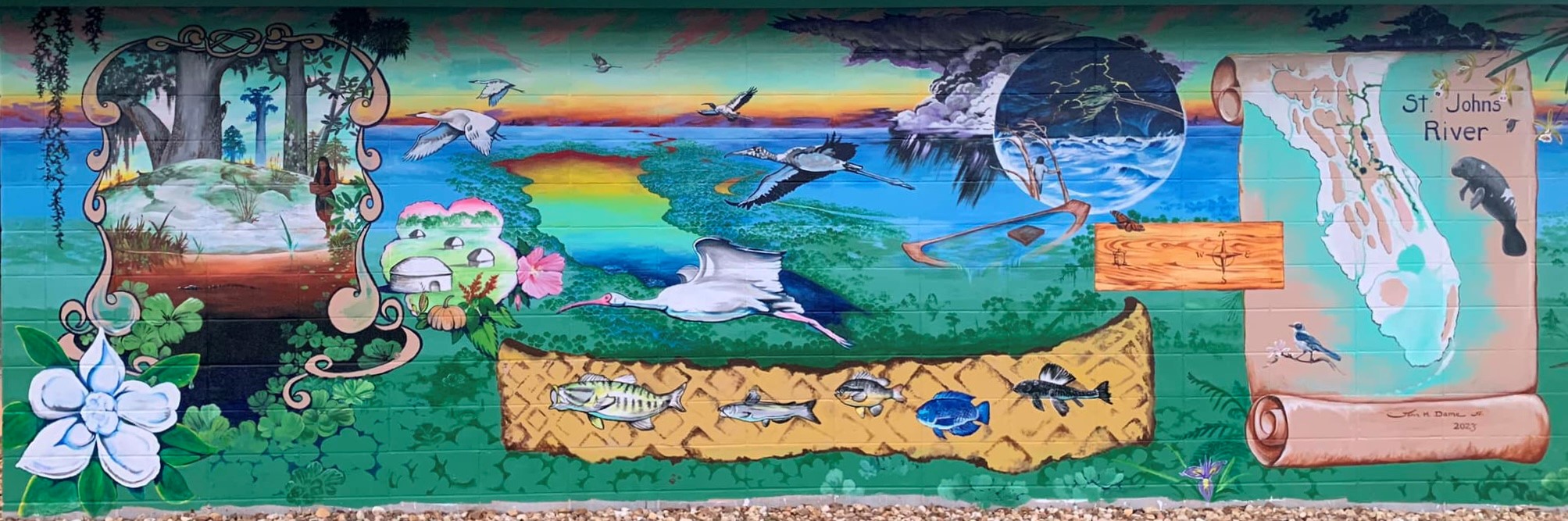
The Lake Beresford Historic Mural, painted by Johnny Dame and student volunteers from Stetson University in 2023, showcases the life found in and around the Lake, as well as its history. The mural depicts the diverse native plants and animals found at the lake and how they coexist in the ecosystem. The mural features endangered species and highlights the efforts to conserve them. Some of the native plants and animals that can be found here include the sabal palm tree, Bartram’s ixia, alligators, and red-tailed hawks.
The mural itself is a focal point of an ongoing body of work by Johnny and Stetson students dedicated to the eco-history of Lake Beresford. Among this body of work is "A Jeux D’eau for Lake Beresford," a ceramic water pot, "The Beresford Suite" by Johnny himself, an audio tour of the site, an educational scavenger hunt, and a documentary, all made or compiled by Stetson students.
Before European settlers arrived, most of Florida was inhabited by the Timucua people, including Volusia County. They used the waterways to trade with other tribes in northern Florida and Georgia. The European settlers came in the 1500s and either incorporated the Timucua into their culture or relocated them to places like St. Augustine or Cuba. They were also forced to convert to Christianity, were enslaved by the settlers, and/or were taken by the diseases the settlers brought to the Americas.
In the 1760s, William Beresford was granted 20,000 square feet of land along the southern St. Johns River as a reward and thank you for his military service. He built a plantation along what he called Lake Beresford, one of the few white settler plantation owners in central Florida at the time.
In 1774, naturalist William Bartram explored and documented the wilderness of Florida by traveling along the St. Johns River, starting in central Florida and ending in Volusia County. Although he faced some terrifying encounters, such as alligators attacking his boat, he was able to sketch and document previously unseen native wildlife, which he named after himself.
In the 1850s and 1870s, more settlers would arrive, most of whom were Confederate soldiers. Most settled in Hontune to develop the land. Andrew Alexander, one of the settlers, used the long-leaf pines to build a dock, a general store, and housing for visitors in what is called Alexander’s Landing. This made the area more attractive to visitors and encouraged them to come. Due to the expansion of railroads in the 19th century, the land became more accessible to people.
Today, Lake Beresford is used for recreation and research. Homeowners have private docks on the lake, and people can be seen fishing, kayaking, boating, and more. The Sandra Stetson Aquatic Center is a multi-purpose building on the lake as well. It is home to IWER and the Stetson Rowing Team. IWER conducts research on the lake and its aquatic life, while the Stetson Rowing Team uses the building and the lake as a practice site. The public also has access to the surrounding trails and public park, where they can see firsthand the unique and diverse blend of nature within this area.
Johnny hid many items in the Lake Beresford Historic Mural. Some of them are compiled into an i-Spy worksheet that can be printed or downloaded to explore the mural. Physical copies of the Beresford Mural i-Spy are also available at the Aquatic Center upon request.
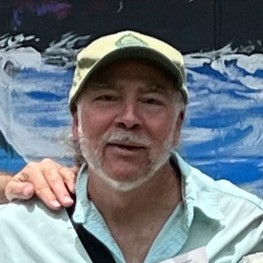
My name is Johnny Dame and I am a Lifelong Artist and Naturalist.I was born in the Peace River Watershed of Central Florida to John and Joye Dame, who were both Phenologists (scientists who study nature over the cycles of time), as were my grandparents, and I was trained by all of them to observe the natural world and to document it through drawings, paintings, handmade maps, writing and music.
Subsequently, I have always been fascinated with the mysteries and glories of the sky, the land, the waters and rocks, and the plants and animals, and the ecosystems.
I have also taken a great interest in the Indigenous Peoples of the Earth, particularly the Native Americans, of which I am Choctaw by heritage.
There is a special energy moving through the Universe affecting all things animate and inanimate. Having recognized this Movement from an early age, I have dedicated my Life to studying and celebrating it. The Lakota have a name that describes it beautifully: "S’kan Taku S’kan S’kan," which translates to "Something in Movement, Spiritual Vitality." The Christian tradition recognizes this as "The Holy Spirit," the Chinese call it "Tao," the People of India call it "Prana," and all ancient cultures have identified it and named it as well. I have chosen to describe it as "The Holy Organic Pattern."
To recognize this pattern is to recognize the Interrelationship of all things, and thus I create my Art with a desire to express my appreciation and devotion of these interrelationships.
We live in a unique time in the development of this Planet and the Human Race and we are faced with the enormous tasks of both healing the Planet and finding sustainable ways to provide the necessary resources for our survival. In the Native American Wisdom Tradition, it is said that all decisions we make should take into account the next seven generations. Each and every one of us holds a piece of this solution, and each of us has a responsibility to share the particular gifts and talents that we have.
It has been said that every time we celebrate beauty, we advance closer to the Heavenly Realm. There are many ways to celebrate beauty, through singing, dancing, painting, writing and praying; the possibilities are infinite!
And this is the primary principle of the Essential Renaissance: celebrate beauty and you are closer to Heaven; create beauty and you bring Heaven to Earth!
In his travels through Florida, William Bartram, the famous Naturalist of the 18th century, often encountered a Spiritual Condition in the Land that would fill him with ecstatic delight. He described it as “Elysian," which translates to "Paradise and/ or Heaven on Earth." I, too, have encountered this Sacred Condition in the Land, and it is from these Blessings in which I am inspired to create!
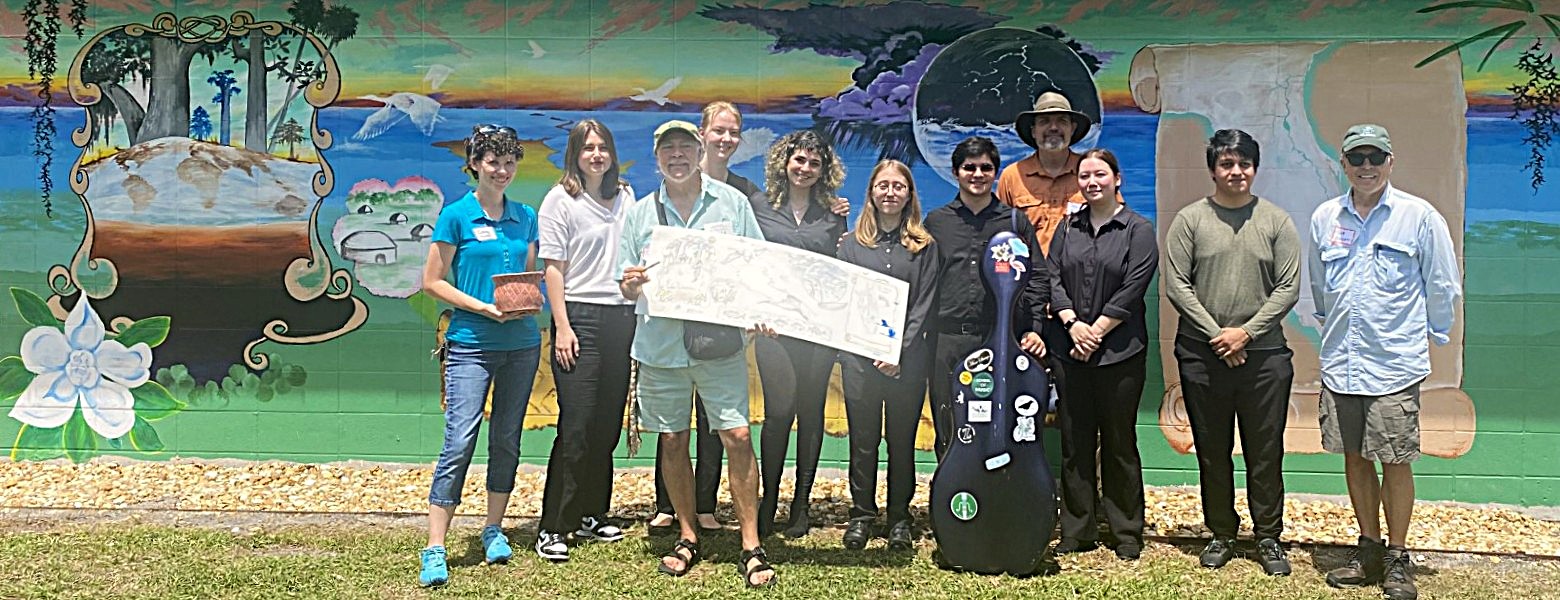
The Lake Beresford Mural came together over several years because to the dedication and creativity of numerous Stetson students.
Student Adam True originated the idea for a mural on the side of the restroom facility at the Aquatic Center. Adam graduated in 2021 from the School of Business Administration. Student Audrey Berlie ran with Adam's idea, and coordinated with artist Johnny Dame, secured sponsors, and connected Stetson students to the project. Audrey graduated in 2024 with her B.S. in Environmental Science and her Bachelor of Business Administration. As a student, Audrey was a co-leader for the Environmental Fellows, a member of the EarthECHO International Youth Leadership Council, a member of the Business Ethics Case Competition Team, an IWER Research Assistant, and a founding member of the Stetson Friends of the Everglades Club. Audrey is now a member of the IWER Advisory Board.
Audrey hosted a competition for a musical composition to accompany the mural's opening. Enter student Luis Quiroz Galvez, who composed A Jeux D'eau for Lake Beresford and graduated in 2023. Students Olivia Corporon (Violin 1), Katarina Nieminen (Violin 2), Briana Mehershahi (Viola), Georgie Gonzalez (Cello), and Britney Pflanz (Vibraphone) performed live on April 22, 2023, on Earth Day for the mural opening.
Student Casey Ramey assisted Johnny Dame in painting the mural and crafted the clay water pot that the indigenous woman holds in the mural. Casey graduated in 2023 with her B.A. in Environmental Studies and was a student employee at the Gillespie Museum, the Hollis Center, and an IWER Research Assistant. In her current role as an IWER staff member, Casey now serves as co-curator of the mural and the supporting body of work with Megan Brinton and IWER Research Assistants. One such Research Assistant is Ella Glover who helped compile the material for this page. Ella will graduate in 2027 with her B.A. in Global Development and an Environmental Sustainability Concentration and is a member of Stetson's Women's Rowing.
Shortly after the mural's opening, Johnny composed "The Beresford Suite," a collection of four musical compositions that expand on the mural's story. Casey connected Johnny with Digital Arts student Aidan Sullivan. Aidan worked with Johnny to record both the music and additional audio descriptions of the mural for his senior project. Aidan graduated in 2025 with his B.A. in Digital Arts.
In the summer following 2023, student and IWER staff member Megan Brinton collected footage and audio from Johnny and the Aquatic Center to make a documentary about the mural. Megan graduated in 2024 with her B.A. in Environmental Studies and later brought on student Madeline Thomas to complete the documentary "The Lake Beresford Mural at the Sandra Stetson Aquatic Center." Madeline pulled material from Aidan's audio exhibit and Megan's original footage to describe the history and significance of Lake Beresford and to capture Johnny's vision for the mural. Madeline is working on her B.A. in Digital Arts and will graduate in 2027. The documentary debuted three years after the mural's opening, on Earth Day 2026.
The creation of the mural was funded by the League of Women Voters of Volusia County, St. John's Riverkeeper, and the IWER Advisory Board.