
Community-Engaged Learning
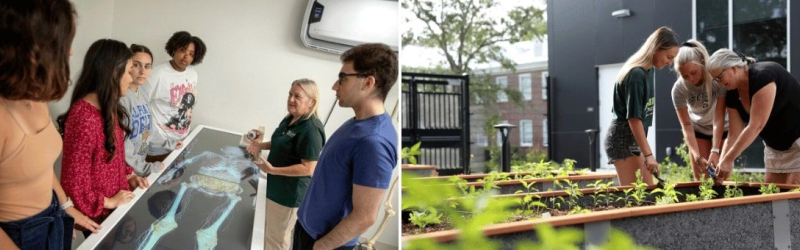
The Center for Community Engagement defines community-engaged learning as "an educational approach that equally supports student learning while meeting the needs of the community." Many Stetson University faculty members work with community partners and communities beyond the campus to facilitate community-engaged learning experiences. Student may pursue community-engaged learning through a variety of coursework and programs at the University.
Community Engagement Service Courses
Community Engagement Service courses cover community engagement topics such as social justice and environmental responsibility and include an experiential education component.
In courses designated as "Community Engagement Service," students should expect:
- The experiential component to be a significant component of the course.
- To engage in critical, meaningful reflection on the intersection of theory and practice and demonstrate that critical reflection in graded work.
- There will be some measurable outcome of service to the community, even if only in number of hours served on site.
ACCT 115 — Volunteer Income Tax Assistance I
- The course covers income tax education and tax preparation software training in order to complete the Internal Revenue Service (IRS) Volunteer Income Tax Assistance (VITA) certification exams for preparation of tax returns in a local VITA program.
ACCT 402 — Federal Taxation of Entities
- The course is a study of the tax laws applicable to corporations, partnerships. Corporations and L.L.C.s Tax research is a part of the course.
EDUC 275V — Human Exceptionalities
- The course presents an introduction to the experiences involved in educating school-aged populations classified as exceptional students. Field experience, with a required background check, within schools or other service-related agencies is required.
FOOD 201 — Beginning Practicum for Sustainable Food Production
- This experiential course provides real-world opportunities for students to develop soil; plant and harvest food; process food for storage and distribution; prepare food for consumption; and manage food waste.
SPAN 313L — Spanish in Communities: Latinos in the U.S.
- In this course, students will complete 35 hours of service-learning through different community sites while learning about diverse social issues and concerns of Latinos in the United States.

Community Engagement Theory Courses
Community Engagement Theory courses focus on underlying social issues and require critical reflection on your positionality.
In courses designated as "Community Engagement Theory," students should expect:
- A significant portion of the course to focus on at least one social problem or need faced by a community and possible roles we may play individually and collectively in solving that need
- Instructors to present subject material in a critical, theoretical, and academic manner using current research in the field.
- To produce some evidence, suitable for grading, that indicates their critical reflection on the role of the individual, acting alone or as part of a larger collective, in solving the social issue(s) discovered in their academic studies for the course.
EDUC 245H — Social Foundations of Education
- This introductory course examines historical, philosophical, and social forces affecting education. Includes systematic observation in public schools.
EDUC 370V — Celebrating Diversity: Examining Populations on the Fringe of Society
- This course examines through film, literature, case studies and field experience the educational and societal implications of poverty, ethnicity, and gender.
HIST 364V — American Feminism(s)
- This course offers a case study in American activism, tracing the many strands of the women's rights movement in the United States from the nineteenth century to the present and placing such activism in the context of its times. The course considers multiple and diverse expressions of women's rights activism, including connections to other movements for social change.
PUBH 303 — Global Health
- The course introduces students to the values, concepts, and functions of public health applied to solving global health problems. Students will learn how social, economic, political, environmental, and cultural factors influence and interact with global health challenges.
PUBH 305V — Food Insecurity Challenges and Solutions
- This course explores the root causes of food insecurity, its social, physical, and mental health impacts and their associations with systemic poverty, health disparities and negative public health outcomes in communities. This class includes a community engagement component where students will visit community food pantries/banks and allied service providers to apply course content beyond the classroom.
SOBA 360V — Social Justice and the Bottom Line
- In this course, students examine how issues of social justice are connected to a wide variety of business practices and systems. Students also explore questions concerning the responsibility of businesses in creating a more just world and examine the relationship between business practices promoting social justice and businesses' bottom lines.
SOCI 375 — Medicine and Health in Society
- This course examines how social structure influences the occurrence of illness and why some social groups suffer more sickness and diseases than others, the experiences of illness, different models/understandings/definitions of illness and how people decide when they are sick, how they respond and cope with the symptoms of various diseases, and how they make decisions about when and from whom to seek help, and finally, the profession of medicine, types of health care providers, and medical technologies and bioethics.
Minor in Civic and Social Responsibility
This interdisciplinary program connects academic coursework with meaningful community involvement, equipping students with the knowledge and skills to contribute to social change in their careers and civic lives. All Bonner students are required to enroll in and complete this academic minor.
Students completing the minor will demonstrate the ability to:
- Explain and analyze, on the basis of scholarly evidence, patterns of social inequality and structures and processes that foster and/or dismantle them;
- Apply their knowledge and skills responsibly and respectfully as a collaborator with one or more organizations or agencies seeking to enhance well-being and equity in the community at any scale, from local to global; and
- Articulate, on the basis of critical reflection on their courses and community collaboration, their sense of responsibility to enhance well-being and equity in the community at any scale, from local to global.
The Minor in Civic and Social Responsibility requires the following:
- One (1) Foundations course (1 unit)
- One (1) Social Justice course (1 unit)
- One (1) Elective course from Foundations, Social Justice, or Community Engagement courses (1 unit)
- CVSR 110: Intro to Community Organizing (0.5 units)
- Community Engagement Component — students choose one of the following two options:
- Complete one (1) Community Engagement course (1 unit) along with a 70-hour community internship (0.5 unit of CSVR 397), for a total of 5 units
- Complete 140 hours of community internship over two (2) semesters (0.5 unit of CVSR 397 each semester), for a total of 4.5 units.
- Capstone Essay
- During their final semester, students will write a reflective essay on their community engagement experience, drawing on both academic learning and hands-on practice to demonstrate personal and professional growth.
For more information on the Minor in Civic and Social Responsibility, community-engaged learning coursework at Stetson, and other academic requirements, please contact [email protected].